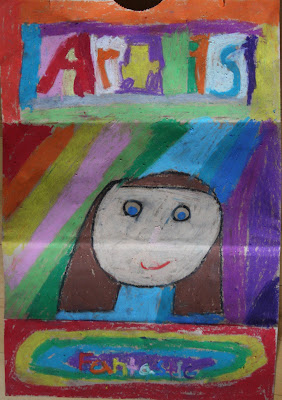
 Art is FANTASTIC
 Art is YUMMY
Art is MAGIC
Art is ME!
Colorful Creative World of Fred Babb
Fred Babb was one of the most colorful, expressive and funky, fun artists of our modern times. He is an absolutely perfect study for our funky fun 3rd graders who love to use color and express themselves. Babb's story is fun to share because he started creating his masterpieces at a young age, in elementary school...about the same age as our third graders. This also makes Babb the perfect focus artist for our upcoming Art Gallery show. Each of our 3rd graders will be able to freely express themselves, showing their parents the artist within.
But before we let their creatively soaked minds, doodle wildly on a canvas, let's start by teaching them about the artist. A powerpoint presentation is available for our classroom and it was created by gathering the information mostly on the Fred Babb site. Share his life with students and then review these 10 questions. Students can show and share with their parents at the Art Show, all the amazing things they know about Fred Babb!
Question 1: What state was Fred Babb born in?
Question 2: What year was Fred born?
Question 3: When did Fred Babb begin expressing himself in art?
Question 4: How did Fred Babb get his art supplies...where did he get his money?
Question 5: How many children were in Fred's family
Question 6: Fred couldn't afford paper, so what did he use as his canvas?
Question 7: What was the name of the Magazine in which Fred found inspiration?
Question 8: Fred did not preplan or pre-sketch his work...how did he do it?
Question 9: As an adult, to earn money for his family, what job did Fred Babb do?
Question 10: What year is Fred Babb pass away?
After reviewing the questions, spend a few minutes brainstorming what art is to them. Art can be magical, fun, colorful, imaginary, and so on... You may need to help some students spell out the larger words. We are just about ready to let the oil crayons roll about, but first, I want to share a sentiment from the blogger at Deep Space Sparkle. She wrote a sweet reminder to all of us art teachers; so simple, so perfect.
"Fred died in 2006. I would have like to have met him. He stood for everything I believe art should be; an extension of oneself that is not necessarily taught, but understood. I try to remember this each time I walk into my classroom and face the little individuals that we often clump together as a whole. I try to remember that each child has a story. Each child has an expression. I don’t always maintain this level of thinking. Often I succumb to the pressures of classroom management and parent expectations. At times, I’m a slave to the minutes on the clock, finishing the project, encouraging the kids along.
Rushing.
Poking.
But when I browse through my collection of Fred’s Art, he slows me down. Reminds me of why I’m here. Nudges me to think in broad terms. Tells me to remember the most important thing of all: don’t let yourself be the reason kids abandon art.
Be the reason why they embrace it…for life."
Thank you Ms Palmer for giving us all some re-focus. :)
Medium: Oil Pastels
Reason for Lesson: To learn about the artwork and the artist Fred Babb, and to explore the limitless self expression in a self portrait using color, shape and tons of imagination.
Prep Time: 20 minutes
Class Time: 20 minutes for lesson time about the Artist, then 45 minutes for art creation.
Materials: Oil Pastels, Paper Sacks* (will require extra prep time) or Black Paper.
* We wanted to have our kids really experience what Fred may have when he created. Using grocery paper sacks will require extra prep time for trimming. Obviously use the side of the bag without the seam. However, keep the seem side to use as a barrier sheet if you plan on storing the art to prevent smearing on other students artwork. To help grocery sacks lay flat, mount on background paper.
Tips for Lesson:
Oil pastels can be a little difficult for 3rd graders to use. They are so excited to dig into their work, they will need to be reminded how to use them, and how easy their artwork can accidentally change with smears. Here is how I suggest they use them. First, if they outline their face using a dark oil crayon, especially black, have them use it last.
Remind students to start their art from the top down. This will help keep their art from smearing and their sleeves clean. Using "imaginary" lines, divide the canvas into three parts. Since we used grocery paper sacks, our imaginary line were organically included.
As suggested above, have the students brainstorm what "art is" to them. We suggest to use the top portion #1 for coloring ART IS.

Next comes the self portrait portion...
Bottom section is for what art means to the student...fun, funky, it'll be fabulous!
Answer 1: Minnesota
Answer 2: 1947
Answer 3: Early elementary school age, around 3rd grade
Answer 4: Fred used his lunch money
Answer 5: Fred was a middle child in a family of eight (8) children
Answer 6: Fred used Grocery Paper Sacks
Answer 7: Mad Magazine
Answer 8: Fred experiences art through the process of creating. He does not begin with ideas, he allows them to present themselves as he works.
Answer 9: Painter and Furniture Refinisher
Answer 10: Fred died in 2006 at age 59