Showing posts with label Shading. Show all posts
Sunday, April 8, 2018
Tuesday, December 5, 2017
Wednesday, February 1, 2017
(Almost 101) Dalmatians - Valentine Style: A Lesson in Line, Shape and Color
Print Making our Background (stop at 3:50):
1. Puppy Guided Draw (stop at 10:20):
(See next slide for step by step).
I love how Mrs. Stephens teaches cutting!
If you want to draw more animals at home with mom or dad, here are the links to the fox, bunny and panda guided draws! First, the fox!
Next, the bunny:
And finally our favorite - pandas!
Thanks for drawing with us today! I hope you love your Valentine Dalmatians!
Tuesday, January 26, 2016
Analogous Ice Cream Cone
Medium: Oil Pastel
Reason for Lesson: Introduction to Color Wheel, Oil Pastels, and Shading technique
Materials:
From Student’s Desk: Pencil, Eraser, Ruler or Straight Edge, Glue Stick
Materials to supply to student:
White paper,
Colored paper to mount artwork on.
Oil Pastels
One crayon – any color – to compare with oil pastels
Plastic cup for circle template
One paper towel – to wipe off the white pastel
Instructions to Lead Lesson:
Introduce the Color Wheel
Define:
Primary Colors – Red, Blue, Yellow
Secondary Colors – colors you make when you mix primary colors: Purple, Green, Orange
Complimentary Color- colors across from one another
Analogous Color – Colors next to each other- our focus!
Tint – When you add WHITE to a color
Shade – When you add black to a color
1. Start with pencils – instruct students on drawing a triangle (use their rulers) for cone on the bottom, and three or four circles for the “scoops”. Students can use the cups to trace circles. Circles should overlap slightly.
2. Erase lines where circles overlap and add a squiggly line, to look like ice cream is melting.
3. EXPLAIN SHADING before students open oil pastels. Shine light on a ball and talk about what side is lighter and what side is darker.
4. Get out Oil Pastels – as a class order them like a color wheel – or rainbow, this will help students determine what colors are analogous/next to each other on color wheel.
5. Have students write name on back of project with the oil pastels,also have them write it with a crayon. Note crayons are made of wax, PASTELS are made of wax plus oil. How does it feel different?
6. Work through the lesson doing one scoop at a time so you can reiterate what “analogous color” means. If they get ahead they will miss the point.
Each student picks a color to do the TOP SCOOP (note: in picture I started with the cone, but it is much better to start at the top and work down so students are not dragging their arm through their work and smudging it.)
SHADING A SCOOP:
a. Outline the top scoop with their color of their choice.
b. LIGHTLY color it in.
c. Make it darker on the left side by adding another coat of the same color pastel
e. WIPE off the white pastel tip if there is any color on it, and add white to the lighter side of the ice cream scoop.
For the next scoop: Students will use an analogous color to the top scoop. In other words if their top scoop was yellow, they could choose orange or green for the scoop below it because yellow is next to those colors on the color wheel.
For the third scoop: choose the next analogous color in order. So if top scoop was yellow, next was orange, and the third would be red. Note, if they started with yellow and went the other way on the color wheel, the order would then be yellow, green, blue, purple.
7. For the cone, choose brown and repeat the shading process
8. Mount work to a construction paper, color of their choice, using a glue stick.
Credit: Color Wheel Fromhttp://static1.squarespace.com/static/5077936f84aeae67a57ea3fa/50e772dde4b0ec03cf8c8d9a/50e772dee4b0ec03cf8c8dd7/1357345509029/
Saturday, October 31, 2015
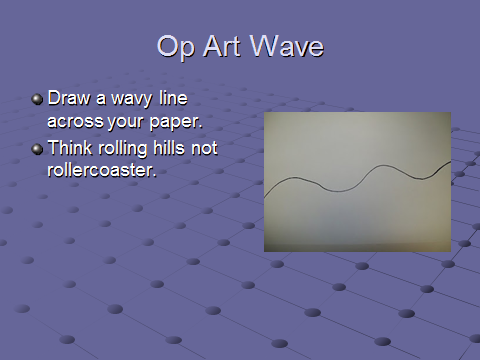
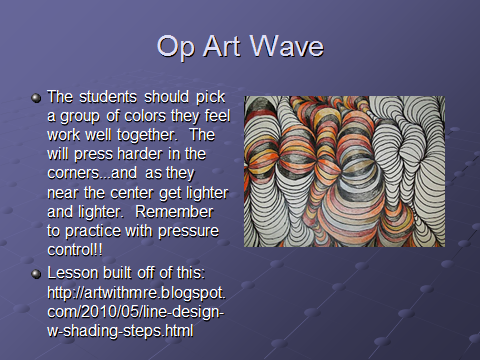
Op Art Waves
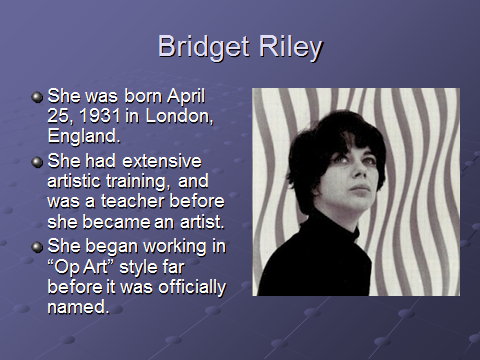
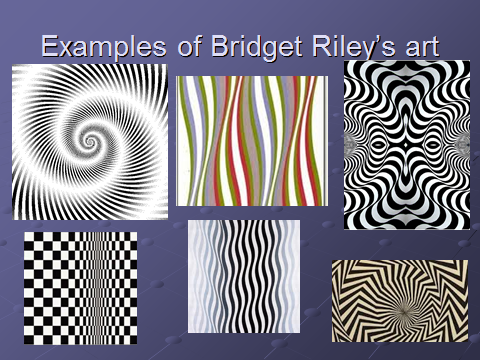
Lesson: Op Art- Waves with Bridget Riley
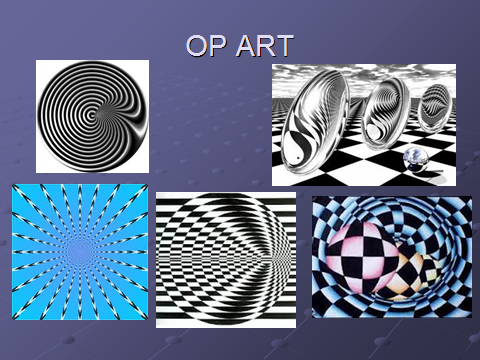
Reason For Lesson: To teach the concept of Op Art, pattern, color and shading
Supplies: Watercolor paper, thin black sharpies, colored pencils
Length of Lesson: 1 hour
Thursday, August 23, 2012
Winter Birch Trees
Medium: Watercolor
Reason for Lesson: The students will learn how to use a paint brush properly and the forgiving aspects of watercolor.
Prep Time: 10 minutes to gather supplies.
Material: Watercolor Paper, watercolors, brushes in various sizes, sponges, white construction paper, scratch paper (for practice), scissors, black permanent marker (shapes) and glue stick.
Instructions to Lead Lesson:
Instruct the students on the proper way to use a paint brush. Instruct them on the forgiving nature of watercolor.
Using a pencil, draw a very light horizontal line...straight or curved they are creating a horizon that will appear behind their trees. Dampen paper with sponge, add sunset with watercolors using cool or warm colors above the horizon line. Blend the colors with a sponge. Add a bit more color making 'clouds of color. Practice painting fence on scratch paper. Paint fence using watercolor...one stroke lines. Cut birch tree truncks from white paper. Add dots and dashes with sharpie marker. Outline fence with sharpie. Mix a lot of water with black watercolor to create a light silver color. Paint fence shadows...one line strokes...practice on scratch paper. Glue birch trees on paper. Add shadows to bottom of trees.
Wednesday, January 4, 2012
Snowmen at Night
One of our favorite art blogs, A Faithful Attempt, posted a project a few years ago for her 6th graders, and our art docent for a 3rd grade class taught it to our students. The project speaks to the wide range of ability throughout various grades! Using chalk pastels, students learn how to draw and shade snowmen being lit by the moonlight. It is a great example of color variation in the given light....cool tones with dark light, warm hues with brighter light. The assignment is based on a beautifully illustrated children's book by Mark Buehner, "Snowmen at Night"
Check out the entire lesson plan here: Snowmen at Night by blog writer, a Faithful Attempt
Here is some of our artfully awesome results:
Check out the entire lesson plan here: Snowmen at Night by blog writer, a Faithful Attempt
Here is some of our artfully awesome results:
Subscribe to:
Posts (Atom)